
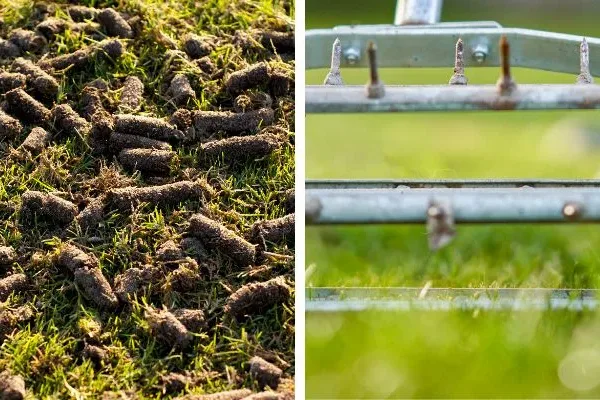
Spike Aeration vs. Core Aeration: Which is Best for Your Texas Lawn?
Just like people, lawns need to breathe. But dense, compacted soil can make that difficult. It can also make it difficult for rainwater and nutrients to penetrate the soil and nurture grass at the root, leading to stunted, sluggish, or sparse growth. In the hot Texas climate, that’s the last thing homeowners need to worry about.
If you have a lawn with heavy, dense soil, or multiple high-traffic areas, you should consider lawn aeration as a part of your lawn care routine. Below, we’ll compare two of the most common types of lawn aeration, how they work, and how difficult they are to implement.
What is Lawn Aeration and Why Does it Matter?
Lawn aeration is a process of creating air pockets in your lawn to allow it to breathe better. These pockets may be long and cylindrical if plugs of soil are removed, or shallow and small if you’ve opted for simply poking holes. Any method of aeration will contribute to a healthier, happier lawn, but the type of aeration you choose will be based on the specifics of your lawn, location, and needs. The two primary types of aeration are spike aeration and core aeration.
Spike Aeration Explained
Spike aeration is often considered a faster, easier, and frequently DIY system for aerating your lawn. It involves poking holes into the soil using any of a number of different garden tools, from pitchforks to specialty aerator shoes with metal spikes protruding from the soles. These spikes are called “tines,” and in the case of spike aeration, it’s always solid tines that are used to penetrate the soil. Solid tines do not go as deep as those used in core aeration (see below), nor do they remove any significant amount of soil from your lawn.
Pros and Cons of Spike Aeration
Like all lawn care methods, there are upsides and downsides to spike aeration.
The pros of spike aeration include:
- Ability to do it yourself with common and inexpensive tools
- Lower overall cost than core aeration
- Can be done faster than core aeration
- Easy to repeat the process as often as needed
- Leaves lawn relatively undisturbed with less mess than core aeration
But of course, there are other considerations to be made when looking at the right type of aeration for your lawn.
The cons of spike aeration include:
- Is time-consuming and requires a lot of effort to do-it-yourself
- Less effective than core aeration
- Increases soil compaction over time as little to no soil is removed
- Only truly effective for small lawns with low-to-moderate compaction
Core Aeration Explained
Core aerators use hollow tines to penetrate soil and remove plugs that can either be completely removed, or left to disintegrate back into the soil (depending on soil type). While core aeration is a much bigger and often more expensive job — and usually better left to the professionals — it’s also far more effective for large lawns, or lawns with extreme soil compaction. Removing soil plugs allows the lawn to breathe, which improves the health of the grass, leading to a lusher, more attractive yard. Core aeration also requires specialized equipment.
Pros and Cons of Core Aeration
Just like spike aeration, there are both positives and negatives to choosing core aeration for your lawn.
The pros of core aeration include:
- Far more effective than spike aeration
- Results last far longer than spike aeration
- Promotes healthier, thicker grass over time
- A greener solution that reduces the need for pesticides and fertilizers
- Works well on larger lawns with densely compacted soil
- Soil plugs provide additional microorganisms for the soil and break down thatch
The cons of core aeration include:
- Higher cost than spike aeration
- Left with aeration holes that may take time to fill in
- Stress placed on your lawn if done too aggressively or too frequently
Core Aeration vs. Spike Aeration: A Comparison
So what’s the bottom line when it comes to choosing lawn aeration that works best for your Texas lawn? It’s all going to depend on your budget, the size of your yard, your access to the right tools, and your ultimate goal for your lawn. This table can help you make the best decision for your lawn needs.
Core Aeration vs. Spike Aeration |
|
| Core Aeration | Spike Aeration |
| Is more effective than spike aeration | Is less effective than core aeration |
| Typically costs more | Frequently more cost-efficient |
| Better when handled by a professional | Can usually be DIYed with a lot of effort |
| Works on large yards with heavy foot traffic and extremely compacted soil | Works best on smaller yards with mild compaction |
| Lessens the need for pesticides and fertilizers | Still requires herbicides and other products to work effectively |
| Less attractive initially, more appealing in the long-term | More attractive in the short-term, but needs to be re-done frequently |
Remember that whichever type you choose, you need to aerate your lawn at the right time for maximum impact. Usually, that means avoiding periods that are too hot and dry, or too wet and cool. In areas of Texas, it may be difficult to avoid hot and dry times, but spring is usually the prime season for lawn aeration (though you can also aerate in the fall).
You may also wish to explore other methods of aerating your lawn. In addition to core and spike aeration, there’s liquid aeration, a less invasive technique that uses a conditioning agent to break down soil and reduce compaction without digging holes. If you’re concerned with the appearance of your yard and want healthy grass that will be lush and green through even the hottest Texas summer, this is a great alternative.
Selecting the Right Aeration Technique
Choosing a lawn aeration method isn’t a quick or simple decision. You likely want results that are noticeable and lasting. While doing spike aeration yourself is tempting, core aeration and liquid aeration are the better options for a healthy lawn.
At Lawn Tech, we offer a variety of lawn care services to meet all of your needs. Check out pricing and request a quote so we can get started with your custom lawn aeration this year!
